
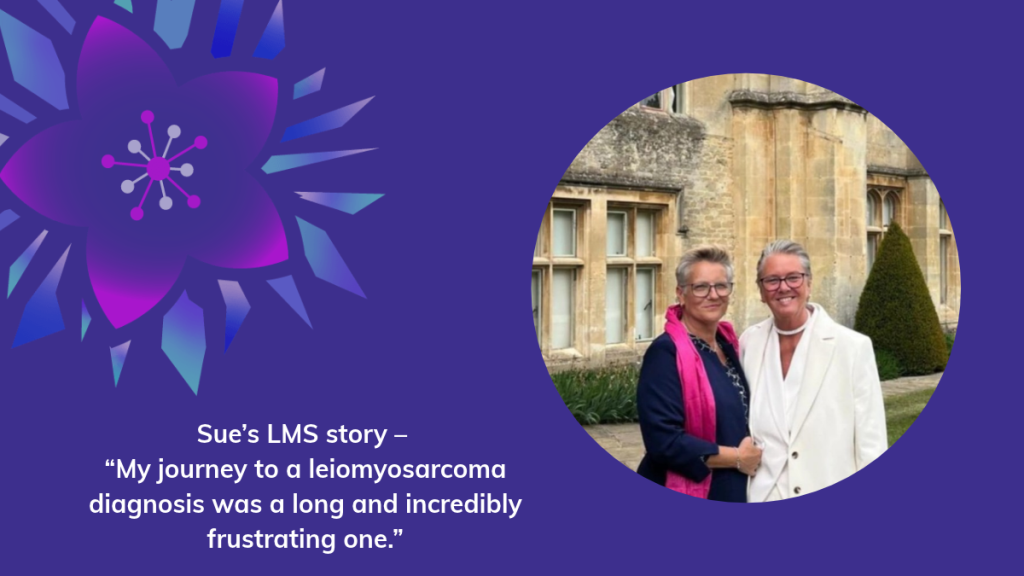
After more than two years of unexplained symptoms, repeated GP appointments and feeling that her concerns weren’t being heard, Sue Strickland-Lord was eventually diagnosed with leiomyosarcoma, a rare form of soft tissue cancer. By the time it was discovered, the tumour had grown to approximately 30cm and required major surgery. Now recovering and determined to help others, Sue shares her experience of diagnosis, treatment and why she believes nobody should be afraid to speak up when something doesn’t feel right.
Meet Sue
Name: Sue Strickland-Lord
Age: 62 at the time of writing her story
Occupation: Teacher and tutor for 20 years
Diagnosis: Leiomyosarcoma (LMS)
When were you diagnosed with leiomyosarcoma?
My journey to a leiomyosarcoma diagnosis was a long and incredibly frustrating one.
For more than two years, I’d been experiencing symptoms that I knew weren’t normal, but I struggled to get anyone to take my concerns seriously.
I was repeatedly told that my problems were related to my age, weight, diet or conditions such as irritable bowel syndrome (IBS).
It wasn’t until I sought further investigations, first while staying in Fuerteventura and later through private healthcare in the UK, that doctors discovered a large mass in my abdomen.
By the time specialists were investigating the possibility of sarcoma, the tumour had grown to approximately 30cm.
After so long feeling unwell, I finally had an explanation for what had been happening to my body.
What symptoms led to your diagnosis?
The biggest symptom was overwhelming exhaustion.
I’d spent 20 years teaching, a career I absolutely loved, but gradually I found myself struggling to get through each day.
This wasn’t ordinary tiredness. It was a deep, relentless fatigue that no amount of sleep seemed to help.
I’d drag myself out of bed, get through the working day on caffeine and determination, then collapse when I got home. Weekends were often spent on the sofa trying to recover.
Alongside the exhaustion, I had persistent stomach pain, nausea, digestive problems and increasing sensitivity to food.
I tried changing my diet, cutting out gluten, dairy and processed foods, and keeping a food diary, but nothing made a difference.
As time went on, other symptoms developed, including anaemia, weight loss, bowel and bladder problems, joint aches and changes to the shape of my abdomen.
Eventually, my stomach became noticeably enlarged.
I knew something wasn’t right, but I couldn’t seem to get anyone to listen.
What difficulties did you face getting a diagnosis?
This was probably one of the most upsetting parts of my experience.
I visited my GP practice repeatedly, explaining how exhausted and unwell I felt, but my symptoms were often attributed to stress, diet, weight or getting older.
I was told to change what I ate, reduce caffeine and get more rest.
At one point, blood tests showed that my folate levels were low, and I was prescribed folic acid. However, I struggled to arrange follow-up investigations.
Later, when I went to donate blood, I was told my haemoglobin was too low.
That was another warning sign that something wasn’t right.
I became increasingly frustrated because I knew my body, and I knew this wasn’t normal for me.
I felt dismissed and unheard, and eventually I began questioning myself.
When a medical professional tells you that nothing serious is wrong, you want to believe them.
But deep down, I knew there was something more going on.
What finally led to your leiomyosarcoma diagnosis?
While spending an extended period in Fuerteventura, I decided to seek medical advice because I was still feeling so unwell.
The GP I saw was wonderful. He listened carefully and arranged comprehensive blood tests, which showed I was anaemic.
He referred me to a digestive specialist to investigate what might be causing the problem.
The consultant arranged an ultrasound, and I will never forget the look on his face as he examined the screen.
He immediately recognised that something wasn’t normal.
Further investigations, including a CT scan, revealed a large mass associated with my uterus.
Initially, it was suggested that this might be a fibroid, but I still didn’t have clear answers.
When I returned to the UK, I decided to seek private medical advice.
The specialists I saw were concerned straight away and arranged further investigations.
The tumour was initially measured at around 25cm and had grown to approximately 30cm within another four weeks.
At last, someone was taking my symptoms seriously.
How did you feel when you were told it could be sarcoma?
Hearing the word “sarcoma” felt like being punched in the stomach.
I’d heard of cancer, of course, but I never imagined it would happen to me.
I’d always considered myself a healthy, active person, and suddenly I was facing the possibility of a very serious diagnosis.
My wife and I had both tried to find simpler explanations for my symptoms.
We knew something was wrong, but neither of us wanted to say the word cancer out loud.
Once the possibility became real, everything changed.
I started thinking about my will, life insurance and how I could make sure my wife would be looked after if the worst happened.
It was heartbreaking to see how frightened she was.
We were both trying to protect each other from the reality of what might happen.
Eventually, we realised we needed to talk openly about it rather than pretending the possibility wasn’t there.
What treatment did you have for leiomyosarcoma?
My treatment involved major surgery to remove the tumour.
When I met my oncologist, he explained that surgery offered the best chance of removing the entire mass.
The operation was scheduled for four weeks later.
During those weeks, I tried to carry on with life as normally as possible, although I was frightened about what lay ahead.
By then, I’d lost around three stone and was incredibly weak.
The surgery turned out to be far more complicated than anyone had expected.
The tumour was deeply embedded and had affected several organs. It had wrapped around my bladder, compressed my colon and become attached to my uterus and an ovary.
To remove it, the surgical teams also had to perform a full hysterectomy and remove part of my colon.
The operation involved several specialist surgical teams working together.
There was significant bleeding, and I needed extensive blood transfusions and platelets to survive.
It was an enormous operation, but thankfully, I came through it.
When I woke up in recovery, I was surrounded by tubes and medical equipment, but I was alive.
And the tumour was gone.
How did your diagnosis and surgery affect your family?
My wife has been my absolute rock throughout everything.
From the uncertainty before diagnosis to the fear surrounding my surgery and the long recovery afterwards, she’s been there every step of the way.
I know how difficult it was for her.
Before the operation, we had to confront the possibility that I might not survive.
She waited for hours while I was in surgery, not knowing whether I would come through it.
When I woke up, she had managed to get into the recovery unit to see me.
Her love, determination and support have meant everything.
During my recovery, she helped me with the smallest things, encouraging me when I was struggling and celebrating every little improvement.
I genuinely don’t know how I would have managed without her.
What was recovery like after your leiomyosarcoma surgery?
Recovery was slow, painful and challenging.
I spent around a week in hospital, learning how to get out of bed, walk and eat again.
When I returned home, I spent much of the following six weeks resting in bed, gradually building up the strength to sit in the lounge and move around.
There were difficult days when I wondered whether I’d ever feel normal again.
But I kept going.
I focused on small achievements, whether that was walking around the apartment, managing a short walk outside or eating a little more.
By around 13 to 14 weeks after surgery, I was beginning to feel a real difference.
The pain had eased, my energy was returning and I was no longer experiencing the overwhelming exhaustion that had dominated my life before the operation.
I’d lost approximately five stone in total, including weight lost after surgery, but I was gradually beginning to regain weight and strength.
My recovery was expected to take many more months, possibly a year or longer, but I was making progress.
I remember reaching a point where it felt as though my body and mind had finally let go of everything they’d been holding on to.
It was like being able to breathe again.
How are things now?
At the time of writing my account, I was around 13 to 14 weeks into my recovery and making encouraging progress.
I hadn’t needed chemotherapy, and I was beginning to enjoy everyday life again without the symptoms that had made me so unwell.
I was told that scans would be an important part of monitoring for any signs of the cancer returning.
Although I was hopeful that the surgery had removed the cancer, I knew that ongoing monitoring would be essential.
The experience has changed me profoundly.
I’m much more aware of my body and the importance of listening when something doesn’t feel right.
I’m also learning to appreciate the small things in life that I might once have taken for granted.
What does your new normal look like?
My new normal is about putting my health first.
After everything I’ve been through, I’ve decided to take time to recover properly rather than rushing back into work or unnecessary stress.
I’m gradually rebuilding my strength and enjoying the things I can do again.
Simple activities that once seemed ordinary now mean so much more.
I have a deeper appreciation for life, for spending time with my wife and for being able to get up in the morning feeling well.
I know recovery takes time, but I’m grateful for every step forward.
Why is speaking up about your health so important to you?
Because I genuinely believe that advocating for myself helped save my life.
For two years, I knew something was wrong, but I allowed myself to be reassured that my symptoms were probably related to age, diet or other common conditions.
I wish I’d pushed harder much earlier.
When I eventually found healthcare professionals who listened and investigated properly, the difference was enormous.
I know how difficult it can be to challenge a medical opinion, especially when you’re already feeling frightened or unwell.
But nobody knows how your body feels better than you do.
If symptoms persist or get worse, you deserve to have your concerns taken seriously.
My experience has made me determined to encourage others to speak up and seek further advice when they feel something isn’t right.
What would you say to someone who feels their symptoms aren’t being taken seriously?
Don’t give up.
Keep a record of your symptoms, including when they started, how often they happen and how they’re affecting your everyday life.
Ask questions. Find out what investigations have been carried out, what the results mean and whether further tests or a specialist referral might be appropriate.
If you’re still worried, ask for another opinion.
I eventually paid for private consultations because I felt I’d run out of options, but I know that isn’t possible for everyone.
What’s important is finding a way to make sure your concerns are heard, whether that’s through your GP practice, another clinician or an appropriate specialist referral.
You shouldn’t feel embarrassed about asking questions or explaining that you’re worried.
And don’t assume that persistent symptoms are simply part of getting older.
You are worth being listened to.
What has kept you positive throughout your experience?
Without question, my wife and the people who have supported me.
I’ve also been incredibly grateful for the care I received from the surgeons, anaesthetist and specialist teams involved in my operation.
They were extraordinary.
The surgery was complex and challenging, but their expertise and determination gave me the outcome I’d hoped for.
I owe them an enormous amount.
I’ve also found support through cancer charities and online groups where people affected by sarcoma and other cancers share their experiences.
Being able to speak to people who understand what you’re going through can make such a difference.
How has your experience inspired you to help others?
I’ve become passionate about raising awareness of rare cancers and encouraging people to advocate for their own health.
I’ve written about my experience because I want others to know that they have a right to be heard.
If sharing my story encourages even one person to seek further investigation, ask another question or get an earlier diagnosis, then something positive will have come from what I’ve been through.
I’ve supported Cancer Research UK and Macmillan in the past, and I’ve also been supporting Sarcoma UK.
I believe research, awareness and patient support are all incredibly important.
Rare cancers need greater recognition, and patients need to know where they can turn for information and help.
I want to use my experience to make a difference.
What message would you give to someone facing a leiomyosarcoma diagnosis?
My message is simple: don’t be afraid to advocate for yourself.
Listen to your body and trust your instincts.
If you’re worried about persistent symptoms, seek medical advice and keep asking questions until you understand what’s happening and what the next steps are.
Make use of the support available from your family, friends, healthcare professionals and cancer charities.
And remember that you don’t have to face everything alone.
I know how frightening a rare cancer diagnosis can be, but I also know how much difference the right care and support can make.
If my story helps even one person, sharing it will have been worthwhile.
You have one life. Make the most of it, speak up for yourself and never forget that you are worth it.
Why Sue’s Story Matters
Sue’s experience highlights some of the challenges that can arise when diagnosing leiomyosarcoma, a rare cancer that develops in smooth muscle tissue.
Symptoms can vary depending on where the tumour develops and may initially resemble those of more common conditions.
Sue’s story also demonstrates the impact of a delayed diagnosis, the challenges of major surgery and recovery, and the importance of patients feeling listened to throughout their healthcare journey.
By sharing her experience, Sue hopes to encourage greater awareness of leiomyosarcoma and empower others to seek medical advice when they have persistent or unexplained symptoms.
LMS Research UK is dedicated to supporting research into leiomyosarcoma, raising awareness of this rare cancer and helping patients and families access information and support.
To learn more about leiomyosarcoma, its symptoms and the work of LMS Research UK, explore the information and support available on our website.